
Global
Perspectives
How travel managers are tackling meetings and events
The travel and events industry has had to adapt a lot in the last five years, and global travel managers are finding a lot more on their plate. The impact of AI efficiency, cost savings, and a post-COVID attitude towards travel has led to a merging of business travel and meetings and events programs. But while travel programs have benefited from decades of tooling, policy maturity, and data visibility, meetings & events sit in a grey area, spread across procurement, finance, HR, and marketing.
Regardless of region, industry, and experience level, travel managers are encountering the same structural obstacles when it comes to meetings & events: unclear ownership, limited data, misaligned KPIs, cultural resistance to compliance, and an overcrowded, disconnected technology landscape. And among global uncertainties, fast-paced technological advancements, and tightening budgets, it’s clear that the current approach to managing meetings and events needs future-proofing.
91%
It will take a fundamental shift to bring meetings and events out of the shadows and into a unified, strategic function alongside business travel. But where does this shift begin? And what does a modern meetings and events program really look like?
You can’t manage what you can’t see. While business travel managers often inherit a centralized system for flights, hotels, rail, and car rentals, managing meetings and events can sometimes feel like putting together a jigsaw puzzle that’s been ransacked by a toddler – you never truly know where the pieces are. Here's the kicker: many organizations have accepted this. They've decided that M&E is too bespoke, too emotional, too complex to standardize. So they tolerate lower visibility than they'd ever accept for business travel.

But here's the truth: M&E visibility isn't fundamentally different from travel visibility. It's just never been given the same infrastructure.
Meetings and events spend takes place across multiple teams, regions, and roles, each operating with their own priorities and processes. Executive assistants, marketing teams, HR, sales, and regional offices all book venues and suppliers independently, often without a shared system or consistent oversight. Data surfaces weeks—sometimes months—after events happen. By then, it's too late to do anything about it.
Colleen Kearney, Freelance Travel Management Consultant, looks at it practically: "It is estimated that 40% of transient travel program spend is on meetings and events. So let's say you're managing a travel program of $200M, that's $80M that most organizations can't even see clearly, let alone manage strategically."
Without visibility, travel managers are flying blind. “Until you find the data and understand the spend, there’s no point talking about KPIs or targets,” says Helen Harris, Global Travel and Expense Manager at KLA, “You need to know what’s actually happening first.”
In practice, invisible data (or shadow spend) allows for leakage, waste, and unmanaged risk to go undetected. By the time problems surface, the opportunity to fix them has passed. Additionally, pitching changes to senior leadership becomes even harder when the evidence isn’t there to back it up.
Visibility reduces risk. Once you can actually see what’s happening, you can move from reactive management to proactive decision-making.
Meetings and events need the same foundational treatment as travel: a centralized way to source venues and suppliers, capture spend, and surface data in real time. By bringing booking activity into one system, organizations can unify data streams from cards, invoices, and expenses into a single reporting layer.
With visibility in place, Travel Managers can establish a true baseline, identify patterns and outliers, and set realistic targets. Visibility doesn’t remove complexity, but it makes it manageable.
Review POs and create a tracking system. Use this as a reliable baseline to identify spend that's inconsistent with existing patterns.
Run regular credit card audits with your finance team. Filter quarterly for hotels, restaurants, venues, and catering suppliers.
Create a simple pre-booking notification form that will act as a heads up for when expenses appear later.
Establish a preferred supplier list and track off-list spend. Make it easy to book approved venues, then review who's going elsewhere and why.
Set up automatic alerts for higher-value transactions. Work with finance to flag any single payment over $10,000 to hospitality or event suppliers.
If everyone owns meetings, is it owned at all? In most organizations, meetings and events aren’t consolidated. Ownership is fragmented: marketing handles social events, HR books internal meetings, EAs manage C-suite schedules, and outsourced spend goes to venue sourcing or event planning.
This decentralization always starts with good intentions – every department has its own ways of working. But true autonomy requires structure, so that independent decisions don’t make everyone else’s job harder.
Meetings and events are being planned and booked independently across organizations, using a patchwork of tools, suppliers, and processes. As a result, you might end up with inconsistencies across supplier negotiations, contracts, and rates. Travel managers are expected to report on or rationalize this spend, despite having limited visibility or understanding of how these decisions are made.
Carol Fergus, Global Travel Manager at Fidelity, compares meetings and events spend to soda. “If you’re buying the same can from ten different shops at different prices,” she says, “wouldn’t it be better to just buy from one supplier in bulk, with a discount?”

Fragmentation costs organizations buying power and negotiating leverage, and event experiences vary widely depending on who’s in charge. Governance also suffers – inconsistent contracting, approval processes, and payment methods increase risk and inefficiency. The result is an erosion of trust as teams play tug-of-war for meetings and events ownership.

Define a clear ownership model for meetings & events. Who sets the strategy? Who governs the process? Who executes the bookings? Which of these responsibilities are outsourced, and which fall on the travel manager? Can any of these steps be made easier with advanced technology?
By introducing tools that work across functions, organizers can give bookers the flexibility and autonomy they need while ensuring data, spend, and supplier relationships are both visible and compliant. When this structure is in place, travel managers can move from fixing problems to actually making a difference.

Travel booking and policy control: Used for booking flights, hotels, and rail, enforcing policy, and tracking traveler data. Common tools are AMEXGBT, Egencia, and Navan.
Expense & spend management: Used for claiming, reconciliation, finance oversight. Common tools are SAP Concur and Expensify.
Employee booking & flexibility platforms: Good for giving employees autonomy while maintaining guardrails. TravelPerk is a popular tool.
Venue sourcing platforms: For venue discovery and bookings. HeadBox uses AI discovery and 3D technology to save time on sourcing and site visits.
Most corporate travel programs are underpinned by well-defined policies, approved channels, and tools that capture spend and enforce rules. Meetings and events rarely benefit from the same level of structured governance, and that gap has real operational consequences.
Corporate travel spend is massive — nearly $1.6 trillion globally in 2025, and an 8% increase projected for 2026. Organizations have invested heavily in structured tools and data to manage it. Travel programs can capture, audit, and enforce policy at scale.
Ailsa Pollard, Category Manager at Murphy, has achieved an impressive 98% compliance of their travel booking tool. The same winning tactics have led to 75% compliance within Murphy’s meetings and events program. “It comes down to having one reliable place for data. If you compare travel with meetings and events, the gap is definitely there. But it’s hard to get people on board with meetings and events without clear KPIs or datapoints.”
When travel is governed through mandated bookings and real-time data, organizations can reduce risk, consolidate spend, and enforce duty-of-care protections. Meetings and events often have none of those advantages.
This becomes a strategic blind spot. Teams can report accurate travel dashboards every month but can't track basic meetings and events spend. Your credibility with finance erodes. Leadership questions your ability to manage the category. And decisions keep getting made on incomplete facts.

The goal isn't to turn meetings and events into a rigid, travel-style practice. In fact, flexibility matters more for bespoke, motion-led experiences like meetings and events. But it’s important to embed compliance into the process, meaning:
Rather than rely on standalone policies few bookers read, governance should be woven into how decisions are made: choosing suppliers, engaging partners, and forecasting costs.
Bake it into the booking flow. Build compliance into the platform—don't rely on separate policy documents.
Make compliance the easy path. If official channels are faster and simpler, people will actually use them.
Track exceptions, not just violations. When someone goes off-policy, find out why and fix the root cause.
Use real-time nudges. Alert bookers in the moment when they're about to go off-policy, not after the fact.
Celebrate wins publicly. Share stories when teams use the system and see results—social proof drives adoption.
We’ve all been there – you propose something new to stakeholders and hear the dreaded but we’ve always done it this way! Tradition and technology will always butt heads, especially with long-standing stakeholders in large, multi-national organizations. However, as the industry changes and technology advances, travel managers need to keep up. The change is inevitable – what’s important is how you propose it so everyone gets on board.
Meetings and events are personal. Unlike booking flights, events carry emotional weight – they’re celebrations, relationship-builders, and experiences molded to company culture. For experienced EAs and senior stakeholders, the current way of doing things isn’t just a process. It’s their process. This resistance isn’t stubbornness. It’s a fear of losing autonomy and control.
Low adoption doesn’t just hurt reporting – it undermines the entire strategy. When employees bypass official channels, spend becomes invisible, preferred supplier relationships go unused, and cost savings evaporate. Travel managers risk becoming blockers instead of partners.
"When people don't use the official booking system, finance can't see events coming," notes Sally Higgs, Travel Solutions Principal at Clarasight. "They only find out about the spend after the money's already gone."
Cultural resistance creates a trust deficit. When bookers feel forced into systems they don’t believe in (or understand), they find workarounds. When Travel Managers push too hard without building relationships, they lose credibility with the very people they need to influence.
It’s important to show more senior employees that this can help them, too, and convince them that they won’t be left behind.
Successful change management requires leading with empathy, demonstrating value quickly and clearly, and building champions within the workplace.
Lead with enablement, not enforcement: Frame new systems as tools that make bookers’ lives easier. Ask for feedback and encourage developing a solution together
Engage EAs and stakeholders as partners early. Gemma Bassett, founder of Curated, built one of the industry’s most successful programs this way. “Hearts and minds,” she says, when asked what exactly she got right. “I treated people internally as partners. I wasn’t afraid to rock the boat when necessary, but I really took the time to understand the business and the priorities of individuals. That’s how you find champions who will back you.”
Use data and quick wins to demonstrate value. People don’t change because they’re told to. They change because they see results. Start with pilot programs that showcase tangible benefits: time savings, better rates, and improved user experiences. Get close to your finance and tech team to build the story.
Change management takes patience and internal PR. But when you build a program that works for the people using it, the results speak for themselves: higher adoption, better data, and stronger relationships.

Identify your ‘super users’. Run a pilot with your most experienced event bookers and let them champion your strategy
Share time-saved metrics as soon as possible using internal data
Celebrate successes publicly when bookings go smoothly
Create feedback loops with monthly surveys
Lead with enablement language: “This will save you time” vs. “This is now required of you”
Travel managers inherit (or create) robust programs with clear KPIs: cost savings, advance booking rates, and supplier compliance. But then meetings and events get added to the role, and suddenly you’re in uncharted territory. No roadmap, no success metrics, no playbook. It’s like driving without a destination.
Meetings and events are being added to travel manager roles without the infrastructure that makes travel programs manageable. There are no agreed-upon KPIs, no industry benchmarks to compete against, and no reference for what a successful meetings and events program looks like.
Each meetings and events program is different. Depending on the industry, company size, and culture, your program may look vastly different from a competitor’s. Because of this, meetings and events are managed reactively – putting out fires, reconciling invoices, chasing approvals – and travel managers are unable to align with broader goals like sustainability, employee experience, and cost efficiency.
My hope for this year is to see meetings and events elevated alongside travel as a strategic priority. They're like two lanes on the same carriageway—moving in the same direction, but each needs its own space to operate effectively. When we respect that, both programs thrive.
Without clear KPIs, it’s impossible to demonstrate value or secure leadership support. Finance wants savings. HR wants employee engagement. Legal wants compliance. Marketing wants brand impact. But if you’re measuring nothing (or measuring the wrong thing), how can you prove delivery?
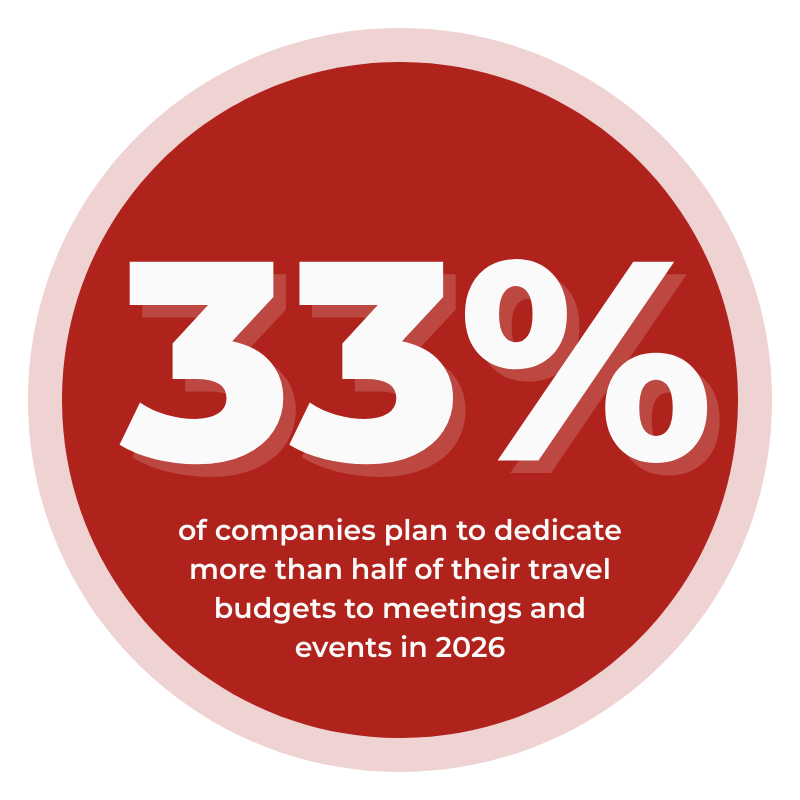
It's also a missed opportunity. Meetings and events spend is significant: Globally, 33 percent of companies plan to dedicate more than half of their travel budgets to meetings and events in 2026. In the Americas, the figure rises to 36 percent. But without KPIs, that investment remains invisible to leadership. You can’t advocate for resources, tools, or headcount without knowing what a successful program looks like.
It’s important to build a framework that reflects the unique nature of meetings and events while aligning with priorities of the business. Before KPIs, ask: what are meetings and events actually trying to achieve for the organization?
Start with visibility. Build a north star goal. Define KPIs that reflect the unique nature of meetings and events. And use data to demonstrate value, secure buy-in, and shift from reactive management to strategic leadership.

Meetings and events may not come with a playbook, but that’s not a reason to operate without one. The solution is to build your own, one rooted in your company’s priorities, shaped by the needs of stakeholders, and grounded in the reality of what you can measure and influence.
Carol Fergus, Global Travel Manager at Fidelity, puts it simply: "Don't be overwhelmed. Take one bite of the cake at a time."
For decades, business travel has benefited from mature tooling, established processes, and clear accountability. Meetings and events have operated differently – fragmented across teams, invisible in budgets, and managed reactively rather than strategically. Travel managers already know how to navigate supplier relationships, build policy compliance, and manage stakeholders. That expertise naturally applies to meetings and events, but it won’t succeed by being forced into a travel mold. Travel managers need to build a framework that respects the unique nature of meetings and events while delivering visibility, governance, and strategic value.
A successful meetings and events program isn’t about rigid compliance or removing autonomy. It’s about creating better conditions for decision-making:
Visibility so you can see what's happening before it's too late
Governance that fits your culture, not someone else's playbook
Data that tells a story leadership can act on
Tools that enable bookers rather than restrict them
Champions who advocate for change from within
Meetings and events will never be as simple or predictable as travel. But it can be managed and measured to free up time and energy for what really matters – creating memorable experiences for attendees that will foster relationships and drive the business forward.
Travel managers everywhere are beginning to shape their meetings and events programs for the better. How will you make a difference?
